


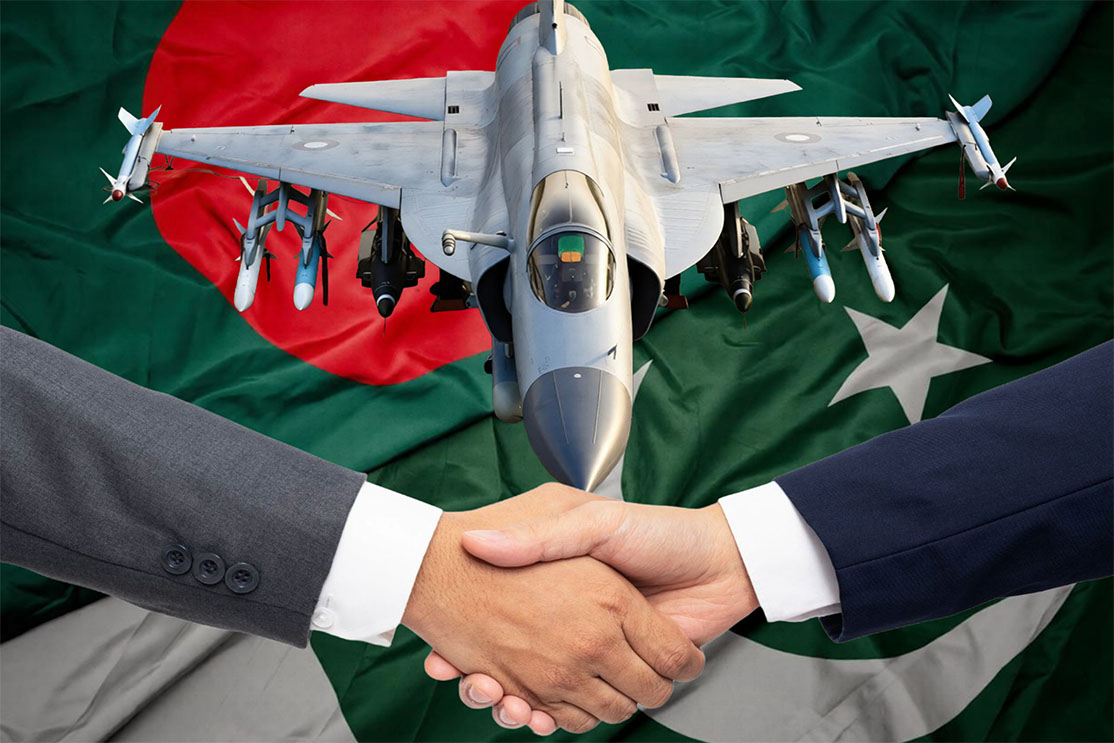
Bangladesh is exploring possible JF 17 fighter jet talks with Pakistan. Here are the key facts, risks, regional reactions and what this could mean.
What is JF-17 and its Character
The JF-17 Thunder is a lightweight, all-weather, multi-role fighter aircraft. The latest version, the Block 3 variant, is considered a 4.5 generation fighter jet, placing it in the same class as Sweden’s Gripen and France’s Rafale. It is designed to offer high manoeuvrability at medium and low altitudes while combining firepower, agility, and survivability. Unlike fifth-generation jets, it lacks full stealth technology, but it features specialized coatings to reduce its radar signature.
How Does It Work
The aircraft operates with advanced avionics and an Active Electronically Scanned Array (AESA) radar, which allows it to track multiple targets simultaneously at long distances. It possesses both air-to-air and air-to-surface combat capabilities and can fire beyond-visual-range missiles. For defense, it utilizes electronic warfare systems and jamming capabilities to disrupt enemy signals. Its operational effectiveness was recently highlighted during a 2025 conflict where it was part of a formation that engaged Indian aircraft.
How They Build JF-17 and Who Are Involved
The JF-17 is a joint venture between the Pakistan Aeronautical Complex (PAC) and China’s Chengdu Aircraft Corporation (CAC). Production is split between the two nations: Pakistan manufactures 58% of the aircraft (including the front fuselage and vertical tail), while China produces 42% (middle and rear fuselage). The complete assembly of the plane is carried out in Pakistan. Other international components include Russian engines and seats from the British manufacturer Martin Baker. The Russian company Mikoyan was also involved in the project.
Why Bangladesh is Choosing Pakistan
Bangladesh is looking to Pakistan primarily to replace its ageing fleet and enhance its air surveillance through integrated radar systems. Several factors make the JF-17 an attractive choice:
- Cost-Effectiveness: The unit cost is estimated at $25m–$30m, significantly cheaper than Western alternatives like the Rafale ($90m+).
- Fewer Political Strings: The package typically comes with fewer “Western political strings” and offers flexible weapons integration.
- Geopolitical Shift: Since the change of government in 2024, Dhaka’s posture toward Islamabad has shifted, leading to a desire for closer strategic alignment.
- Combat Record: Recent performance against the Indian Air Force has bolstered the jet’s reputation as a “combat-proven” platform.
How Big is This Deal and What are the Perks
While a final contract has not yet been signed, the deal is described as a “potential procurement” currently under review. Other recent JF-17 deals suggest the scale could be massive; for example, Azerbaijan signed a deal worth $1.5bn, and a deal with a Libyan faction reached $4bn. The perks for Bangladesh include:
- Fast-tracked delivery of Super Mushshak trainer aircraft.
- A comprehensive training framework for pilots, ranging from basic to advanced specialized courses.
- Long-term maintenance and after-sales services, ensuring the fleet remains operational for decades.
How Will India See This Deal
India is likely to view this deal with concern as it signals a strategic shift in South Asia. The discussion between the air chiefs of Pakistan and Bangladesh is seen as an indicator of improving relations between Islamabad and Dhaka following the ousting of the pro-India Sheikh Hasina government in 2024. Furthermore, the deal involves a fighter jet that Pakistan aggressively markets based on its perceived success in aerial combat against India.
Will This Deal Be Sealed
Currently, the deal is in the discussion and review phase; Bangladesh has expressed “interest,” but a formal contract has not been signed. Analysts suggest that while marketing is aggressive, fighter jet procurements typically take years to move from exploratory talks to delivery. However, the Pakistani military views the ongoing talks as a reflection of a shared desire to build a long-term strategic partnership.

Since the change of government in August 2024, Bangladesh has experienced a major shift in its geopolitics. One sign of this change is the strengthening bond between Bangladesh and Pakistan. Recently, the Bangladesh Air Force has held detailed discussions about the potential purchase of the JF-17 Thunder fighter jet from Pakistan.
This move is significant because of regional rivalries. China and India have had border disputes for decades, and Pakistan has a similar history with India. While the idea that “the enemy’s enemy is a friend” exists in diplomacy, good geopolitics requires a careful balance. India has expressed concern over this potential deal. While it is Bangladesh’s right to choose its own partners, we must manage this carefully. We share a border with India and depend on them for trade in food and electricity.
A strong nation needs more than just a military. It needs a good healthcare system, education, and clean air. However, a strong defence is also vital for national interest. The JF-17 Block 3 is a smart choice for a country on a budget. It is a 4.5-generation multi-role fighter equipped with advanced radar and long-range missiles.
At a cost of $25 million to $30 million per jet, it is much cheaper than Western planes like the Rafale, which costs over $90 million. Currently, the deal is in a review process. But it shows that Bangladesh is looking for a long-term strategic partnership to modernize its ageing fleet.
Today’s partner can be tomorrow’s headache if diplomacy is ignored, NO?
– Daily ScrollDown
Source: Al Jazeera, Prothom Alo, BBC