



Bangladesh’s startup scene was once growing fast. Now it is slowing down a lot.
Funding has dried up, local investors have pulled back, and founders are struggling in an uncertain economic and political climate. The sector is not collapsing but the era of easy money is over. This shows deeper problems that need fixing.
For much of the past decade, Bangladesh’s startup ecosystem was seen as a quiet success story in South Asia. A young population, more smartphones, and digital services drove it.
That hope has faded. With the funding crunch, building a startup has become much harder. This is not a collapse, but a prolonged slowdown. This situation raises questions about the strength of the earlier boom and whether elections can restore confidence.
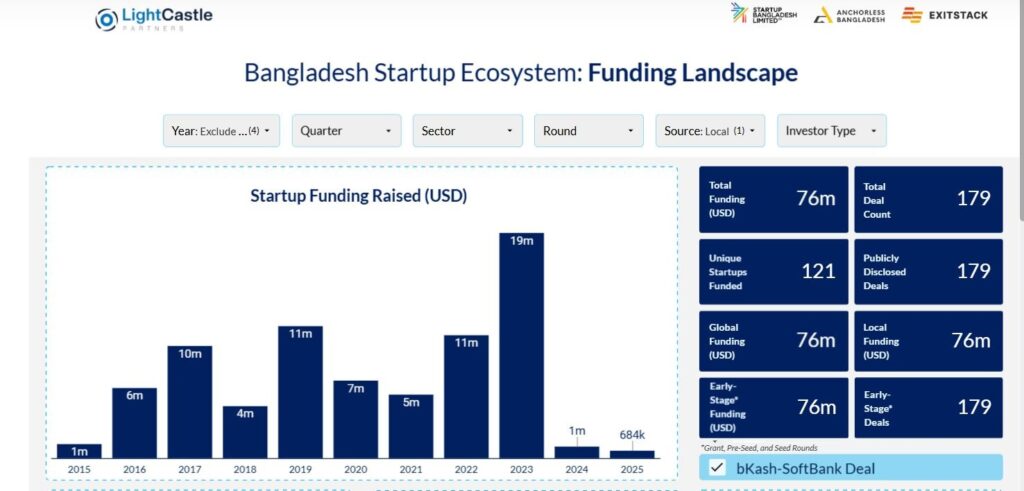
Investment by The Local Investors Throughout The Years
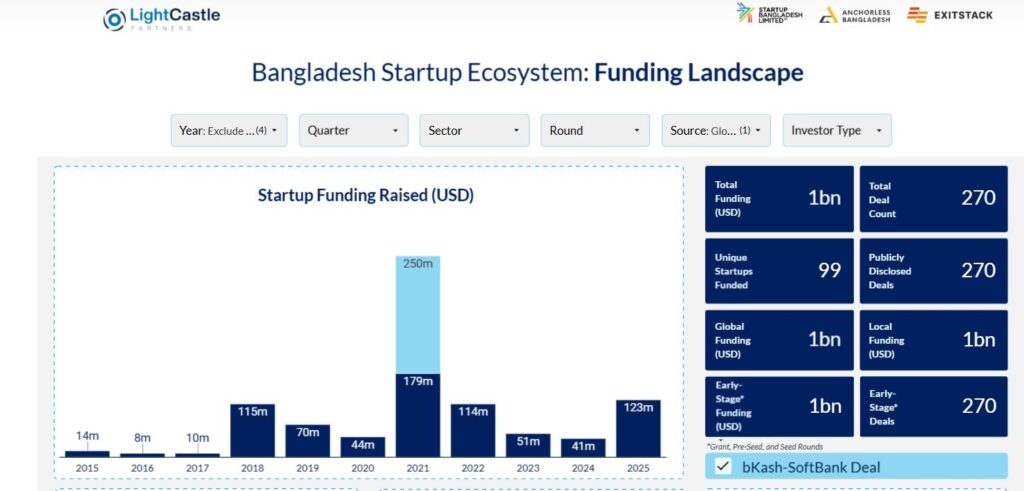
Investment by The Global Investors Throughout The Years
Startup funding fell a lot in 2024. It reached about $41 million. This is the lowest in nearly six years. Local funding dropped even more by around 95%.
Sajid Amit, a financial expert and academic, said political stability after elections may help improve investor confidence. But deeper institutional issues matter more in the long run. He also said that investors ultimately respond to the quality of governance. It includes the rule of law, transparency, corporate practices, and the strength of institutions. Without meaningful improvements in these areas, using funds effectively would be difficult.

The Bangladeshi startup ecosystem is going through an evolution rather than a collapse. The thin layer of hype has faded, exposing a market. That now demands resilience, discipline, and real value creation.
As the February 12, 2026, national election approaches, the economy appears to be holding its breath. Investors have stepped back not because money has disappeared, but because trust has. Political uncertainty, frequent street protests disrupting daily life, and risk free government bonds offering returns of around 10 percent have made caution the rational choice. Investors are choosing the certainty of survival over the promise of growth.
This has created a “too big to burst” situation. The ecosystem is not crashing in a single moment, but slowly thinning out. A lack of local capital has exposed long-standing weaknesses, especially a copycat culture where success in one sector quickly leads to overcrowding. The hype of edtech startups following early success stories is a clear example. While this kind of imitation helps prevent monopolies, it also creates noise instead of innovation. Startups should focus on solving long-standing, real problems, not simply entering whichever sector is trending.
To survive this startup winter, founders must move beyond polished pitch decks and buzzwords. Build a stronger connection between book knowledge and street knowledge. Understanding how businesses actually operate in Bangladesh’s informal, cash-heavy, and often unpredictable environment matters more than replicating foreign models.
Policy remains another critical pressure point. Recent steps, including Bangladesh Bank’s July 2025 circular allowing banks to invest a portion of profits as equity and offer lower-interest loans to startups, are positive. However, taxation and compliance rules still treat early-stage startups like big companies. Without tax relief, clearer regulations, and incentives, growth will remain limited.
The upcoming election is widely seen as a potential reset moment. Investors are watching closely for signs of political stability, policy continuity, and real implementation of promised reforms. The question is not whether Bangladesh has talent or ideas. But whether the country can create an environment where startups are helped to stand up.
– Opinion | Daily ScrollDown