


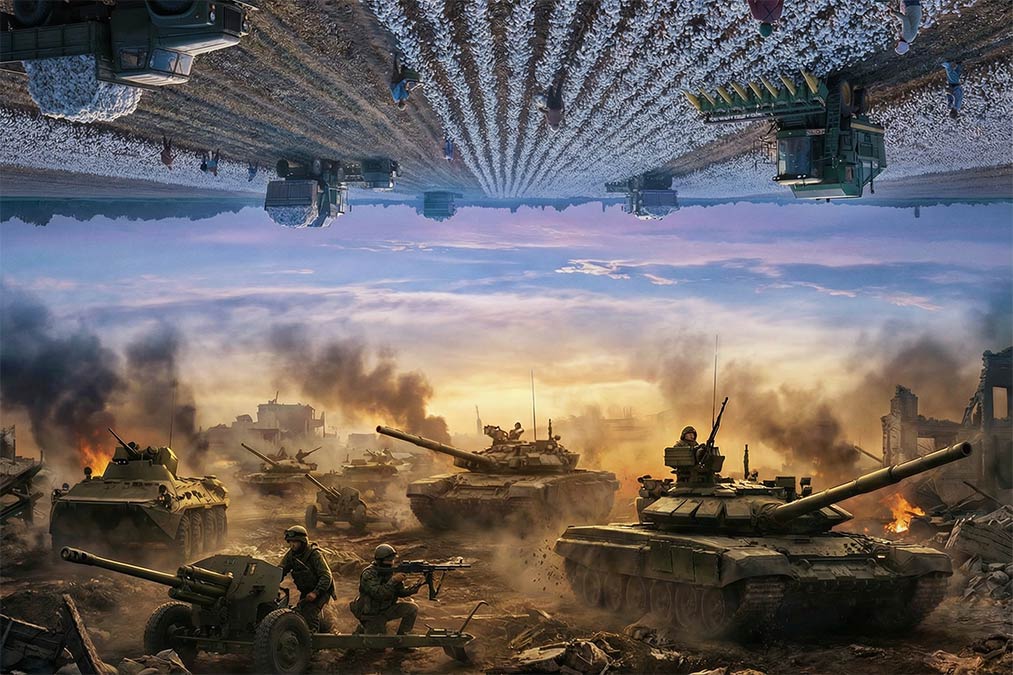

Putin is not easy to corner. Russia’s war machine is powered by one simple engine: oil. Sell oil, earn money. Earn money, fund defense. As long as that loop works, the war can continue.
There is a deep irony in how this is playing out.
Ukraine once gave up its nuclear weapons in exchange for security guarantees from the West and Russia. Today, it is fighting for survival. At one point, former US President Donald Trump publicly suggested Ukraine should give up access to its mineral resources in exchange for support. The idea was widely criticized because it clashed with the principle that Ukraine had already sacrificed for global security. The contrast is hard to ignore.
The US and the European Union are trying to break this cycle to stop the war in Ukraine. Sanctions are the main weapon. But sanctions only hurt when buyers disappear.
Now, pressure has shifted to oil buyers.
The US and EU are tightening sanctions and, more recently, using tariffs as punishment against countries buying Russian oil. India is the clearest example. Under the current US policy, Indian goods face penal tariffs that can stack up to nearly 50 percent in some cases. As a result, India’s imports of Russian oil have dropped sharply.
Here comes the irony.
Earlier in the war, under the Biden administration, US officials openly encouraged India to buy discounted Russian oil to keep global prices stable. What was once pragmatic is now punishable. Same action. Completely different response.
But Washington cannot apply the same pressure to China.
Why? Because the world depends on China for two critical things. First, China dominates the extraction and processing of rare and strategic minerals essential for electronics, batteries, green energy, and defense. Second, China controls global supply chains for low cost manufactured goods. Pressuring China too hard risks global economic shock. That gives Beijing leverage.
For now, China remains Russia’s top oil buyer.
Economists say Putin has little immediate reason to stop the war. As long as oil buyers exist, defense funding is not an urgent problem. When buyers shrink, Russia dips into its National Wealth Fund. That fund is falling fast, but it is not empty yet.
Stopping the war may now be harder than continuing it …
Putin has built a wartime economic ecosystem. Sanctions force import substitution. The government supports domestic industries with subsidies and protection. Businesses profit. The state bleeds. Soldiers earn two to three times more than civilian wages, and families receive large compensation payments. For many regions, war has become an income source.
At the same time, the Kremlin controls the narrative through state media. Propaganda works. Public dissent stays limited. Prices of basic goods are kept artificially affordable for lower income groups, reducing social pressure.
History suggests wars like this usually end not because leaders want peace, but because money runs out. Russia is not there yet. The fund still exists. Oil still sells.
Putin is a tough nut to crack because the system he built survives on oil, fear, money, and time.
The war will not stop when Russia feels pain.
It will stop when Russia cannot pay for it anymore.
The war will not end because Russia suddenly feels economic pain. It will end when sustaining the war becomes structurally harder than stopping it.
– Opinion | Daily ScrollDown